Why your prompts give you forty versions of the same answer
The five-part shape behind a prompt that produces something usable — including the step almost everyone skips — with the same request written badly and then properly.
CG
Channel Grow
Sep 2026—7 min read
You ask for forty hooks. You get forty versions of the same hook. You ask for a script and get something that reads like a press release. The model is not the problem — it will happily produce forty genuinely different hooks. It just was not told enough to know which forty you wanted.
Prompts that work have a shape. It is not a secret and it is not clever; it is five parts in a particular order, and most people skip the one that matters. Here is the whole thing, and then twenty-one prompts that already have it built in.
The five parts
1. A role — the weakest part, and the one everyone uses
"You are an expert scriptwriter." This narrows the vocabulary the model reaches for. That is all it does. It is worth one line and no more, and a prompt that consists only of a role will produce generic output every time, which is why "act as an expert" prompts disappoint people.
Keep it, keep it short, and do not expect it to carry the prompt.
2. Context slots — what the model cannot guess
Who the video is for, what they already know, what platform, how long, what tone. Left out, the model writes for a generic audience, which is nobody.
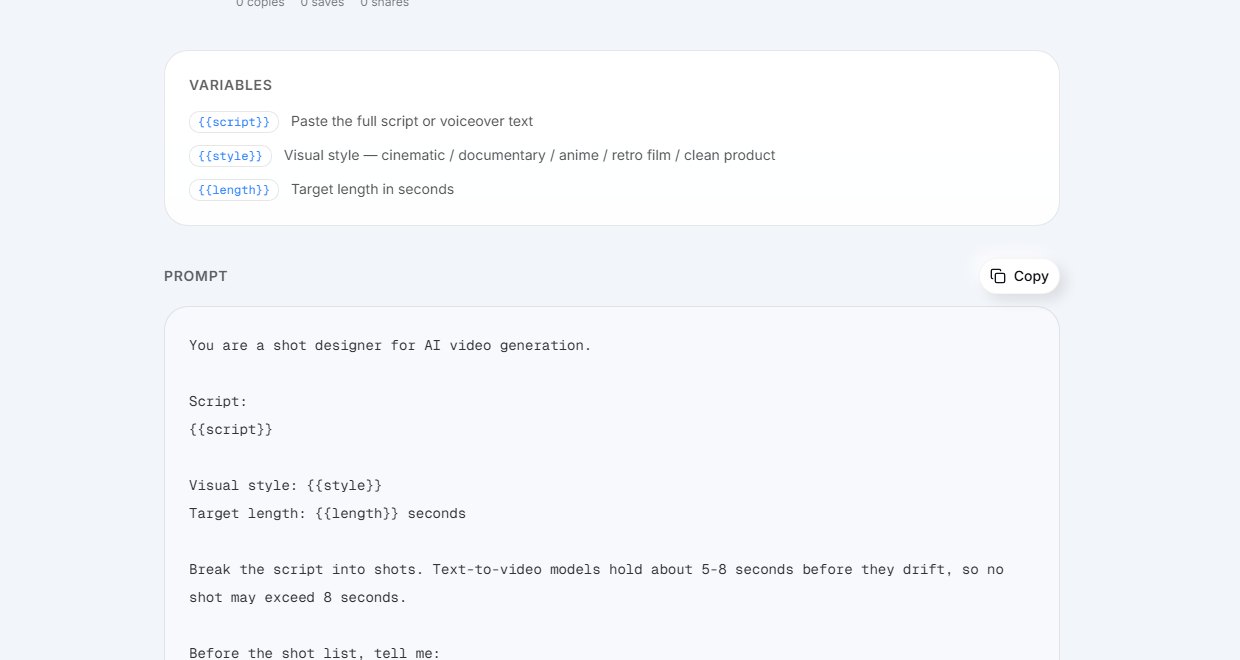
The trick is to make these slots rather than sentences, so the prompt is reusable:
Now it is a tool you fill in, not a paragraph you rewrite every time. Every prompt in our library is written this way.
3. Diagnose before producing — the part that actually changes the output
This is the one almost everyone skips, and it is the difference between forty variations and forty options.
Before asking for the deliverable, ask the model to state its reasoning:
Before writing anything, tell me:
1. The strongest angle to use
2. The main problem to focus on
3. The biggest objection to overcome
4. The clearest benefit to lead with
Two things happen. The model commits to an angle instead of hedging across all of them — which is what produces the mush. And you get to correct the angle before it spends the whole answer on the wrong one. If it says the main problem is X and you know it is Y, you fix that in one line rather than regenerating forty hooks.
If you take one thing from this article, take this.
4. Counted deliverables
"Write me some copy" gets you an essay. "10 headlines, 3 angles, 1 final version, 3 calls to action" gets you something you can pick from.
Counted output is also checkable — you can see at a glance whether the model did what you asked, which you cannot do with "some ideas". Ask for more than you need. Ten hooks where two are good is a good result; the two would not have existed if you had asked for two.
5. An explicit list of what to avoid
A model with no constraints writes the median of everything it has read. On the internet, the median hook is "you won't believe this" and the median ad is "game changer".
So name them:
Avoid: "this changed everything", "nobody is talking about this",
"I wish I knew this sooner", fake urgency, exclamation marks,
and any sentence a real person would not say out loud.
Being specific matters. "Avoid clichés" does nothing — the model does not know which ones you mean. Listing the actual phrases does.
The same request, twice
Here is a prompt most people write:
Write me some hooks for a video about faceless YouTube channels.
And the same request with the five parts in place:
You are a hook writer for short-form video.

Topic: how faceless channels actually get their first 1,000 subscribers
Audience: beginners who have posted under 10 videos and have no traction
Platform: YouTube Shorts
Goal: make them watch past 5 seconds

Before writing, tell me:
1. What this audience already believes that is wrong
2. The objection that makes them scroll
3. The one promise worth leading with

Then give me 15 hooks, split into: curiosity, pain-point,
contrarian, and direct-benefit. Mark the 3 strongest and say why.

Avoid: "nobody is talking about this", "I wish I knew this sooner",
"this changed everything", and any hook that could open a video
about literally any topic.
Same model, same topic, roughly ninety extra seconds of typing. The second one produces hooks about this video. The first produces hooks about videos in general, which is why they all sound alike.
What it looks like when it is built for you
The Script to Shot List prompt. The slots are declared at the top so you know what to fill in before you read the body.
All twenty-one prompts in our library follow the five parts. They are free to copy, and the variables are listed separately so you can see what a prompt needs before you commit to reading it.
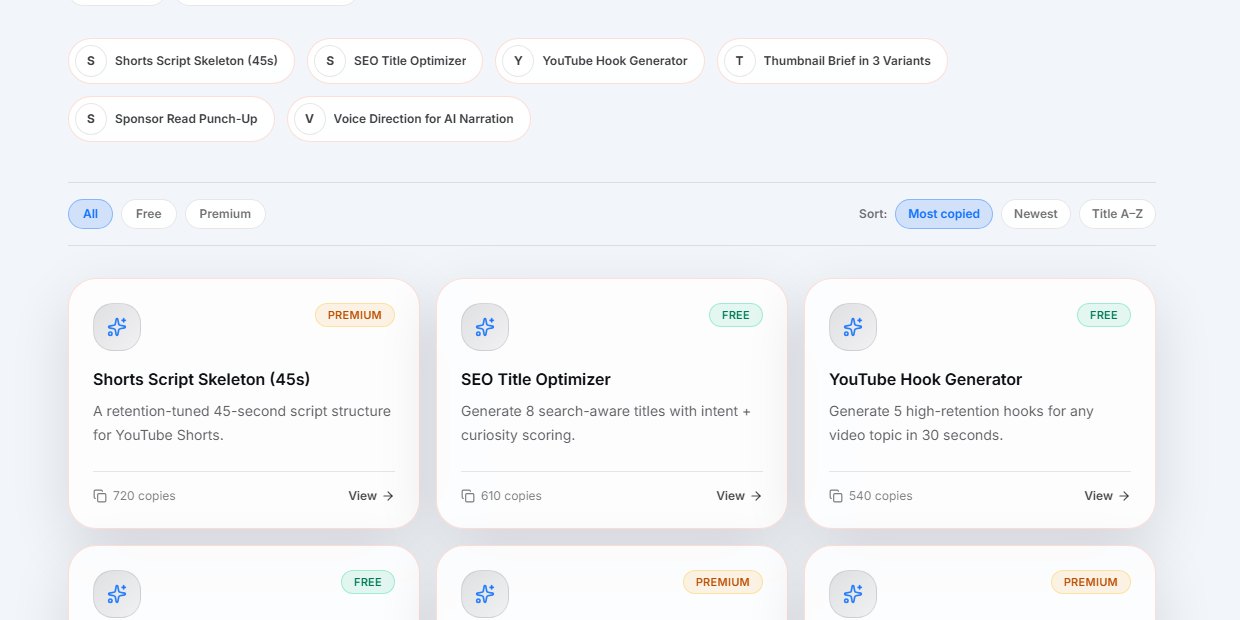
Where to start, by what you are stuck on
Grouped by the stage of the workflow rather than alphabetically, because that is how you will actually look for them.
Ideas and scripts
30-Video Content Plan — a month of ideas for one niche, each with its hook and format
The full library at /prompts, filterable by free and premium.
Questions people ask
Does this work on every model?
The structure does. The wording does not need to change between ChatGPT, Claude and Gemini — all three respond to a stated angle and counted output. Where they differ is length: some will happily give you thirty items, others quietly stop at ten and you have to ask again.
Isn't a long prompt a waste of time?
It is roughly ninety seconds against regenerating four times. The break-even is immediate. And with slots you write it once and refill it, which is the entire reason for the {{variable}} notation.
Why ask the model what it thinks before it writes?
Because an angle you disagree with is cheap to fix in one line and expensive to fix after forty outputs have been built on it. It is also the fastest way to find out the model misread your brief.
Should I tell it to avoid AI-sounding writing?
Only if you name what that means. "Sound natural" is not actionable. "No sentences under five words, no exclamation marks, no starting a sentence with 'And here's the thing'" is.
Do I need the paid models?
Not for this. Structure closes most of the gap between a cheap model and an expensive one; an unstructured prompt on the best model available still produces the median of the internet.
A note on where this comes from
None of this is proprietary. The role-context-diagnose-deliver-avoid shape turns up across most well-made prompt packs, including several sold as products, and the reason it keeps turning up is that it works. What we have not done is republish anyone's prompt library — the twenty-one prompts linked above are written here, for people making faceless and AI-assisted video, which is a narrower job than the general marketing packs those frameworks usually serve.
They are free to copy and use commercially. If one of them produces something bad, tell us and we will fix the prompt.